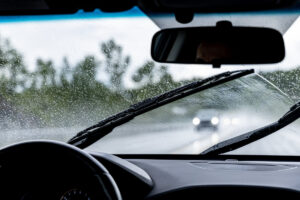
 When visibility drops on a rainy Pennsylvania highway, every second counts. Windshield wipers are one of the most overlooked safety systems in a vehicle, yet their failure can reduce a driver’s field of vision to near zero in seconds. When a crash results from wipers that stopped working, smeared instead of cleared, or simply weren’t adequate for the conditions, the legal questions that follow can be surprisingly complex. Determining who is responsible, and whether that failure entitles an injured person to compensation, requires a careful look at the facts surrounding both the malfunction and the collision.
At Rubin, Glickman, Steinberg & Gifford P.C., our car accident lawyers understand how mechanical failures contribute to serious crashes and how to build cases that account for every contributing factor. Named a “Best Law Firm” every year since 2010 by U.S. News & World Report and AV-rated by Martindale-Hubbell, our firm has spent decades helping injured Pennsylvanians navigate the legal process with clarity and confidence.
How Wiper Failure Contributes to Crashes
Windshield wiper malfunctions can take several forms, each capable of creating dangerous conditions behind the wheel. Worn rubber blades leave streaks that distort a driver’s view of the road ahead, while a failed motor can cause the wipers to stop moving entirely in the middle of a storm. Detached arms, cracked refills, and freeze-up in cold weather are all common culprits.
According to the Federal Highway Administration, weather conditions are a factor in approximately 12% of all vehicle crashes in the United States, with rain being the most frequently cited weather event. When impaired visibility from a faulty wiper system prevents a driver from reacting to hazards in time, the connection between the defect and the crash can be direct and documentable.
Pennsylvania law requires drivers to maintain their vehicles in a safe operating condition. That responsibility extends to windshield wipers, which must be in working order whenever precipitation affects visibility. A driver who knew or should have known that their wipers were failing and continued operating the vehicle in adverse weather may be found negligent. That negligence can become the foundation of an injury claim filed by anyone harmed as a result.
Who Can Be Held Liable
Identifying the right defendant in a wiper-related accident claim depends on the specific facts of the case. The parties who may bear legal responsibility include the following:
- The driver, if they failed to maintain the vehicle or ignored visible signs that the wipers were not functioning correctly
- A repair shop or mechanic, if the wipers were recently serviced and the work was performed improperly
- A vehicle manufacturer or parts supplier, if the wiper system was defective from the factory, or a replacement component was flawed
Each of these scenarios involves a different legal theory and a different path to compensation. A driver’s negligence claim differs significantly from a product liability case against a manufacturer, and the evidence required to prove each one varies accordingly. Understanding which theory applies to a particular situation is one of the first steps in evaluating whether a claim has merit.
What Injured People Need to Prove
A successful personal injury claim arising from a wiper failure typically requires demonstrating that a party owed a duty of care, that they breached that duty, and that the breach directly caused the plaintiff’s injuries and resulting damages. Evidence that supports these elements might include vehicle inspection records, photographs of the damaged or worn wiper system, weather reports from the time of the crash, eyewitness statements, and expert testimony from automotive or accident reconstruction specialists. Surveillance footage from nearby traffic cameras or businesses can also be valuable in establishing the sequence of events leading to the collision.
Importantly, Pennsylvania follows a modified comparative negligence rule, meaning that an injured party can recover compensation as long as they were not more than 50% responsible for the accident. If the injured person bears some degree of fault, such as following too closely in poor weather, their recovery may be reduced proportionally, but it is not automatically eliminated. This makes it essential to work with attorneys who know how to investigate the full picture and position a case as effectively as possible. Victims of accidents caused by vehicle defects may also have intersecting claims worth exploring through our truck accident lawyers or motor vehicle accident attorneys, depending on the circumstances.
Steps to Take After a Wiper-Related Accident
The actions taken in the hours and days following a crash can have a meaningful impact on the outcome of a legal claim. Seeking immediate medical attention creates a documented record linking injuries to the event, while preserving the vehicle in its post-accident condition can be critical if a defective wiper system is suspected. Photographs of the scene, the weather conditions, and the vehicle components involved should be taken as soon as it is safe to do so.
Reporting the accident to law enforcement and obtaining a copy of the police report are equally important. If a product defect is suspected, it may also be worth consulting with attorneys who can arrange for an independent inspection before the vehicle is repaired or destroyed. Evidence in wiper failure cases can disappear quickly, which is why prompt legal guidance matters so much. Our personal injury lawyers can help evaluate whether a product liability claim might run alongside a traditional negligence case based on the initial facts.
Rubin, Glickman, Steinberg & Gifford P.C. Is Ready to Help
If you or someone you love was injured in a crash where faulty wipers played a role, the team at Rubin, Glickman, Steinberg & Gifford P.C. is prepared to help you understand your rights. Our attorneys have earned recognition from Best Lawyers in America and have maintained a peer-reviewed AV rating from Martindale-Hubbell since 1992, reflecting our commitment to high standards of legal and ethical representation. We bring both big-firm resources and small-firm personal attention to every case we handle, and we work on a contingency basis in personal injury matters, meaning there are no fees unless we recover on your behalf.
To discuss the details of your situation with a member of our legal team, we welcome you to contact us for a free initial consultation. Serving clients throughout Southeastern Pennsylvania, including Montgomery County, Bucks County, and surrounding communities, our attorneys are committed to fighting for the results you deserve.

Rubin, Glickman, Steinberg & Gifford P.C.
Pennsylvania Attorney's
March 11, 2026