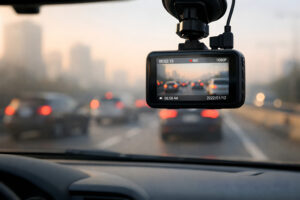
You watched the video a dozen times before you even called anyone. The other driver ran the light. It is right there, timestamped, undeniable, and yet you still find yourself wondering whether a screen recording can really settle a fight that started on the road.
At Rubin, Glickman, Steinberg, and Gifford P.C., we work with drivers across Pennsylvania who assume their dashcam footage speaks for itself. Sometimes it does. Other times the same footage becomes the piece of evidence the other side uses against them, and that difference usually comes down to what happened in the seconds before the crash, not just the moment of impact.
What Dashcam Footage Can Prove in a Pennsylvania Car Accident Case
Dashcam video captures what witnesses often cannot describe accurately after the fact. A driver running a stop sign, a sudden lane change without a signal, or a vehicle following too closely all show up clearly on footage in a way that memory rarely preserves months later. When the other driver disputes fault, or when a police report leans on incomplete statements, your dashcam recording can fill in the gaps that would otherwise leave your claim resting on conflicting accounts.
Some dashcam models also log speed, GPS coordinates, and timestamps alongside the video. That data can confirm how fast a vehicle was traveling or where exactly the collision happened, which becomes useful when an insurance adjuster tries to argue that you were partially at fault. We often pair this kind of footage with the official police report to build a more complete picture of how the crash occurred.
Why Footage Alone Is Not Always Enough
Pennsylvania courts do not simply accept a video because it exists. Under the rules governing authentication of evidence, the party offering the footage must provide enough proof that the recording is connected to the actual person, place, or event in question. That typically means showing the footage has not been altered, establishing a clear chain of custody, and confirming the timestamp and metadata line up with the reported accident. Skipping these steps can leave otherwise strong footage vulnerable to a challenge before a judge ever considers what it shows.
This is one of the areas where we focus early in a car accident claim. We know what insurance companies look for when they try to discredit video evidence, and we take steps to preserve the original file, document how it was obtained, and verify that nothing about the recording invites doubt about its authenticity.
How Dashcam Footage Can Hurt Your Claim
A dashcam does not selectively record. If the footage shows you following too closely, glancing at your phone, or making an unsafe maneuver moments before the crash, that same video can be used to argue you share some responsibility for what happened. Pennsylvania follows a modified comparative negligence rule, so if your own footage suggests any fault on your part, the amount you can recover may be reduced accordingly.
Poor footage quality can create problems of its own. A grainy image, an obstructed lens, or a camera angle that fails to capture the other vehicle clearly may not hold up as persuasive evidence, and it can even work against you if the insurance company argues the video is incomplete or misleading. Before submitting footage to an adjuster, it helps to review these factors carefully:
- Clarity: The footage should clearly show the vehicles, road conditions, and any traffic signals involved in the crash.
- Continuity: Unedited footage that includes the moments before and after the collision carries more weight than a short clip.
- Metadata: Timestamps and location data, when available, strengthen the connection between the footage and the reported crash.
- Scope: Footage that only shows part of the incident can raise questions the other driver’s attorney may try to exploit.
Reviewing footage with these points in mind before it reaches an adjuster or a courtroom can make the difference between evidence that supports your claim and evidence that complicates it.
What We Do With Your Dashcam Footage
We start by reviewing the full recording, not just the clip a client thinks is most important, since context before and after the crash often matters as much as the collision itself. From there, we work to confirm the footage meets Pennsylvania’s authentication standards, cross-reference it against the police report and any available witness statements, and identify anything in the video that the other side might use to shift blame.
We also help clients understand what a fair settlement should reflect once all the evidence, including dashcam footage, has been properly evaluated. Video can be a powerful tool in a car accident claim, but only when it is handled correctly from the moment the crash occurs through the negotiation or litigation that follows.
Talk to Rubin, Glickman, Steinberg, and Gifford P.C. About Your Dashcam Evidence
Since 1992, we have carried an AV rating for legal and ethical standards under the Martindale-Hubbell Peer Review Rating process, and we have been named a “Best Law Firm” by U.S. News & World Report every year from 2010 to 2022. That recognition reflects the same attention to detail we bring to reviewing dashcam footage, police reports, and every other piece of evidence in your case.
If you have dashcam footage from a recent crash and are not sure whether it helps or hurts your claim, we encourage you to reach out. Our team can review the footage, explain what it means for your case, and help you understand the next steps. Contact us today to talk through your situation and find out how we can help.

Rubin, Glickman, Steinberg & Gifford P.C.
Pennsylvania Attorney's
October 6, 2026